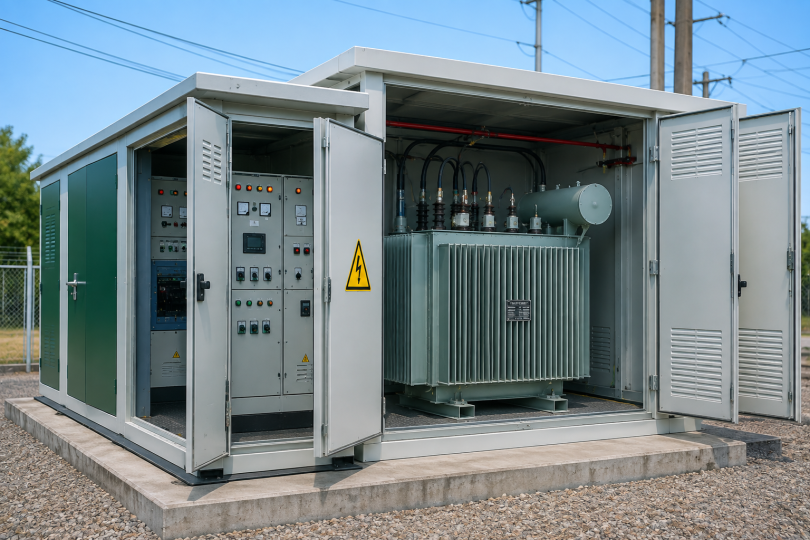

A compact substation transformer combines transformer equipment and essential substation components within a relatively small footprint. This arrangement is useful for industrial facilities, commercial buildings, renewable energy projects, infrastructure sites, and distribution networks where available space is limited.
Compared with larger conventional installations, compact substations can simplify site planning while providing controlled voltage transformation and power distribution. Their enclosed construction can also help protect electrical equipment from environmental exposure and accidental contact.
What Is a Compact Substation Transformer?
A compact substation transformer is part of an integrated electrical installation designed to receive electrical power at one voltage level, reduce or increase the voltage as required, and distribute it to downstream circuits. Depending on the installation, the equipment may include a transformer, medium-voltage switchgear, low-voltage distribution equipment, protection devices, and associated connections.
The transformer itself performs the voltage conversion. Switchgear and protection equipment control the incoming supply and help isolate equipment during faults or maintenance.
This configuration is particularly useful where a conventional open substation would occupy too much land or require a more extensive civil installation.
Main Components and Their Functions
A compact substation normally contains several coordinated electrical components.
Transformer Unit
The transformer changes the incoming voltage to a suitable level for distribution or equipment use. Its rating is selected according to the expected load, voltage requirements, operating conditions, and future capacity needs.
Medium-Voltage Switchgear
Switchgear controls the incoming medium-voltage supply. It can provide isolation, switching, and fault protection, depending on the equipment arrangement and project specifications.
Low-Voltage Panel
After voltage transformation, power reaches the low-voltage section. Circuit breakers, busbars, metering equipment, and outgoing feeders may be installed here to distribute electricity safely to different loads.
Protection and Monitoring Equipment
Protection devices help detect abnormal electrical conditions such as short circuits, overloads, or earth faults. Monitoring equipment can provide information about voltage, current, temperature, and other operating parameters.
How It Differs From a Conventional Substation
Space is one of the clearest differences between a compact substation and a traditional substation arrangement. Conventional substations may use separate outdoor areas for transformers, switchgear, protection equipment, and distribution panels. A compact arrangement brings several components together in a controlled enclosure or packaged configuration.
An electrical substation transformer used within such an installation must still meet the required electrical and thermal specifications. The compact design does not remove the need for correct transformer sizing, protection coordination, earthing, ventilation, and maintenance access.
The physical arrangement simply makes better use of the available installation area.
Where Compact Substation Transformers Are Used
A compact substation transformer can suit a wide range of applications.
Industrial plants may use these systems to supply production machinery, motor loads, lighting, and auxiliary equipment. Commercial developments can use them to distribute power to buildings where electrical demand is higher than a standard low-voltage connection can provide.
They can also be used in infrastructure projects, transport facilities, data-related facilities, utility distribution networks, and renewable energy installations.
The final configuration depends on the voltage level, capacity, environmental conditions, protection requirements, and local electrical standards.
Understanding the Electrical Substation Arrangement
An electrical transformer substation generally receives electrical energy from an upstream network and changes its voltage before sending power toward consumers or other sections of the network.
The transformer is connected to switching and protection equipment so that electrical faults can be managed without unnecessarily affecting the wider network. Proper earthing is also required to provide a controlled path for fault currents and reduce dangerous touch and step voltages.
In a compact installation, these functions are arranged within a smaller footprint. The enclosure and internal layout must still provide adequate insulation, clearances, heat dissipation, and access for authorized personnel.
Choosing the Main Transformer for a Substation
The main transformer in substation installations should be selected after assessing the electrical load rather than simply choosing a rating based on the present maximum demand.
Engineers typically consider:
- Primary and secondary voltage
- Transformer capacity
- Load characteristics
- Short-circuit conditions
- Ambient temperature
- Cooling requirements
- Installation location
- Protection requirements
- Future load growth
- Applicable electrical standards
Load diversity also matters. Not every connected load operates at full capacity simultaneously, so the expected demand profile should be assessed before selecting the transformer rating.
Oversizing can increase initial costs and may affect operating efficiency, while undersizing can create excessive loading and thermal stress.
Substation Power Transformer Considerations
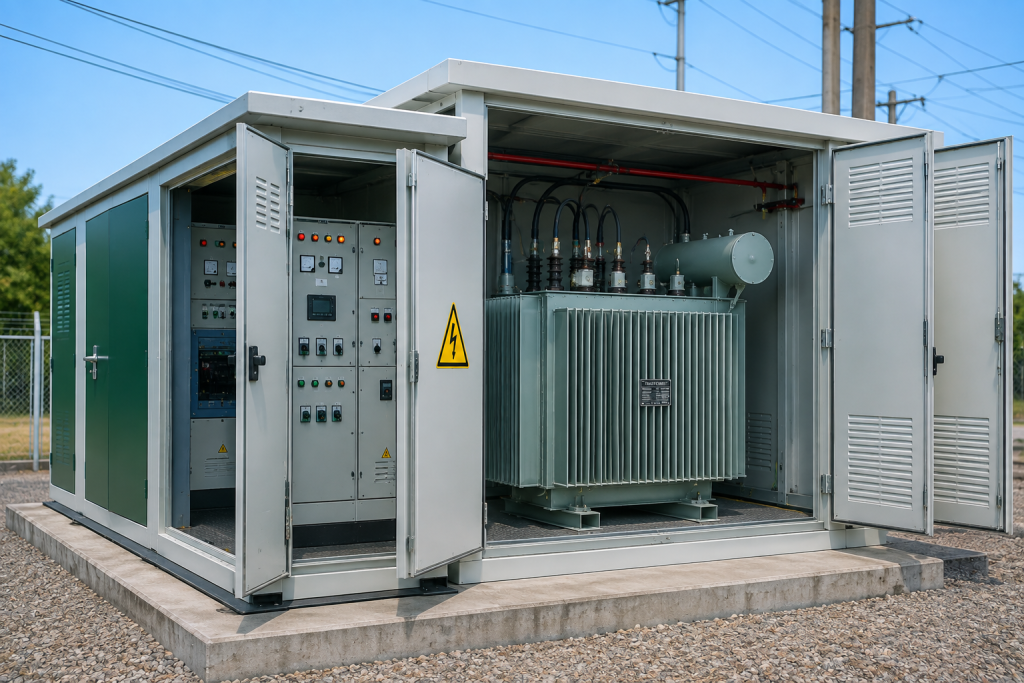
A substation power transformer must be capable of operating reliably under the expected electrical and environmental conditions. Transformer efficiency, impedance, insulation system, cooling method, and temperature rise are among the technical factors that influence equipment selection.
For outdoor installations, the enclosure and construction should account for rain, dust, humidity, temperature changes, and other site conditions. Coastal or chemically exposed locations may require additional consideration because corrosive environments can affect external components.
Noise can also matter near residential, commercial, or occupied areas. The transformer design and installation arrangement should therefore be assessed against the site’s acoustic requirements.
Installation and Maintenance Requirements
Although compact substations occupy less space, they still require sufficient clearance for inspection, servicing, cable termination, switching operations, and component replacement.
The foundation must support the equipment’s weight and maintain the required alignment. Cable routes should be planned before installation so that bending radii, termination arrangements, and access requirements are respected.
Regular maintenance can include visual inspections, checking connections, examining insulation and protection equipment, cleaning accessible areas, and monitoring transformer temperature and operating conditions. Maintenance intervals should follow the equipment manufacturer’s instructions and applicable electrical regulations.
Buying Substation Transformers for a Project
When comparing substation transformers for sale, buyers should look beyond the transformer rating and purchase price. Technical documentation, voltage ratings, efficiency, impedance, cooling arrangement, insulation class, enclosure design, testing requirements, and compliance with relevant standards should all be reviewed.
The site conditions should also be communicated clearly to the supplier. Information such as indoor or outdoor installation, ambient temperature, altitude, humidity, available space, incoming voltage, required outgoing voltage, and expected load can affect the appropriate specification.
Factory testing and documentation can provide useful confirmation that the equipment meets the agreed technical requirements before delivery.
Why Compact Designs Suit Space-Limited Sites
A compact arrangement can reduce the land required for electrical equipment and simplify the physical layout of a project. This can be particularly useful at sites where additional land is expensive or unavailable.
The reduced footprint may also shorten internal cable runs and place related equipment closer together. However, compact construction should never compromise access, ventilation, electrical clearances, or safe operation.
Good site planning remains necessary from the initial design stage through installation and commissioning.
Final Considerations
A compact substation transformer is suited to electrical installations that require dependable voltage transformation within a controlled and space-efficient arrangement. Correct transformer sizing, protection, earthing, environmental assessment, and maintenance planning determine how effectively the installation performs over its service life.
For any project, the transformer and associated substation equipment should be specified according to actual electrical requirements, site conditions, applicable standards, and expected future demand.