Blog

  • Breakthrough Industry Predictions Every Leader Must Know

    Breakthrough Industry Predictions Every Leader Must Know

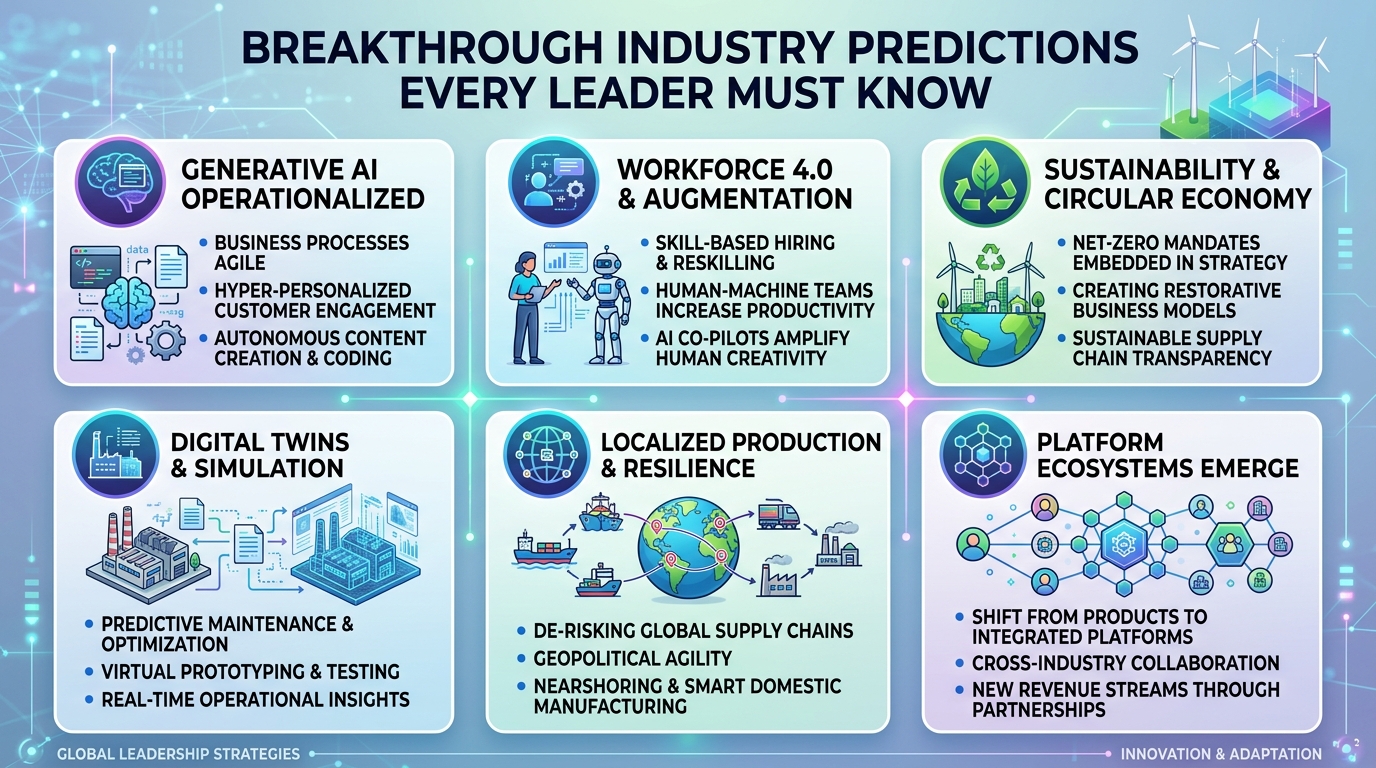
    Industries across the world are evolving at a speed that is difficult to ignore. In 2026, leaders are no longer only reacting to change—they are expected to anticipate it. Breakthrough innovations in artificial intelligence, automation, sustainability, and global digital transformation are reshaping how businesses operate. Understanding these industry predictions is essential for leaders who want to stay competitive and future-ready.

    Artificial Intelligence Becoming the Core of Every Industry

    Artificial intelligence is no longer a separate technology trend; it is becoming the foundation of modern business operations. From healthcare to finance, AI is being integrated into decision-making, customer service, and data analysis.

    In the coming years, industries that fail to adopt AI-driven systems may struggle to compete. Leaders must prepare for a future where AI supports almost every operational process, improving speed, accuracy, and efficiency.

    Automation Reshaping Workforce Structures

    Automation is transforming how companies manage their workforce. Repetitive tasks are increasingly being handled by machines and software systems, allowing human employees to focus on creative and strategic work.

    This shift will redefine job roles across industries. Leaders will need to invest in reskilling and upskilling programs to prepare employees for more advanced responsibilities in an automated environment.

    Rise of Data-Driven Decision Making

    Data is becoming one of the most valuable assets in modern business. Organizations are using advanced analytics to understand customer behavior, market trends, and operational performance.

    Leaders who rely on data-driven insights rather than intuition alone will have a significant advantage. Predictive analytics will also help businesses anticipate future trends and make smarter decisions.

    Sustainability Becoming a Business Priority

    Sustainability is no longer optional; it is becoming a core business requirement. Governments, consumers, and investors are pushing companies to adopt environmentally responsible practices.

    Industries such as manufacturing, energy, and transportation are expected to undergo major transformations to reduce carbon emissions and improve resource efficiency. Leaders must align business strategies with sustainability goals.

    Digital Transformation Accelerating Globally

    Digital transformation continues to reshape every industry, from retail to education. Businesses are shifting to cloud-based systems, digital platforms, and remote operations to improve flexibility and efficiency.

    This transformation is also changing customer expectations. Users now demand faster, more personalized, and seamless digital experiences across all services.

    Growth of Remote and Hybrid Work Models

    The traditional office structure is evolving rapidly. Remote and hybrid work models are becoming standard in many industries, supported by digital communication tools and collaboration platforms.

    Leaders must focus on building strong digital workplace cultures that maintain productivity, engagement, and team coordination regardless of location.

    Expansion of Cybersecurity Needs

    As digital systems grow, so do cybersecurity threats. Industries are investing heavily in protecting data, systems, and user privacy from cyberattacks.

    Cybersecurity is expected to become one of the most critical business priorities. Leaders must ensure that security strategies evolve alongside technological advancements.

    Blockchain Moving Beyond Cryptocurrency

    Blockchain technology is expanding beyond digital currencies into supply chain management, finance, healthcare, and identity verification.

    Its ability to provide transparency, security, and decentralization makes it valuable for industries that require trust and data integrity. Leaders are increasingly exploring blockchain-based solutions for operational efficiency.

    Customer Experience Becoming a Key Differentiator

    In highly competitive markets, customer experience is becoming more important than product or price alone. Businesses are focusing on personalization, faster service, and seamless digital interactions.

    AI-powered tools and customer data analysis are helping companies create highly personalized experiences that improve satisfaction and loyalty.

    Future of Leadership in a Changing World

    Leadership itself is evolving. Modern leaders must be adaptable, tech-aware, and forward-thinking. Decision-making will increasingly rely on technology insights and global market awareness.

    Successful leaders will be those who embrace innovation, encourage continuous learning, and guide organizations through constant change.

    FAQs

    What is the biggest industry trend in 2026

    Artificial intelligence integration across all industries

    Why is automation important for businesses

    It increases efficiency and reduces repetitive manual work

    How is data changing decision-making

    It allows leaders to make more accurate and predictive decisions

    Why is sustainability important for industries

    It helps reduce environmental impact and meets global regulations

    What skills do future leaders need

    Adaptability, digital knowledge, and strategic thinking

    Conclusion

    Breakthrough industry predictions show that the future of business will be shaped by artificial intelligence, automation, sustainability, and digital transformation. Leaders who understand and adapt to these changes will be better positioned to succeed in a rapidly evolving global economy. In 2026 and beyond, innovation and adaptability will define the most successful organizations.

  • How GVD Custom Home Builder Can Transform Your Vision into Reality

    How GVD Custom Home Builder Can Transform Your Vision into Reality

    GVD Custom Home Builder is known for turning ordinary ideas into beautifully designed living spaces by combining architecture, craftsmanship, and personalized planning. In 2026, custom home building is no longer just about construction—it is about creating a lifestyle experience tailored to individual needs, preferences, and long-term comfort. Companies like GVD focus on understanding client visions and transforming them into fully functional, modern homes with precision and care.

    Understanding Your Vision from the Start

    The first step in any custom home journey is understanding what the homeowner truly wants. GVD Custom Home Builder emphasizes detailed consultation sessions where clients share their ideas, lifestyle needs, and design preferences.

    This includes everything from room layouts and architectural style to energy efficiency and future expansion plans. By focusing on communication early in the process, builders ensure that the final design reflects the client’s personality and expectations.

    Personalized Design and Planning

    Once the vision is clear, the design phase begins. GVD specializes in creating customized home plans that align with both aesthetics and functionality. This stage involves architects and designers working closely with clients to refine floor plans, structural elements, and interior layouts.

    Modern tools like 3D modeling and digital visualization help homeowners see their future house before construction begins. This reduces uncertainty and ensures that every detail is carefully planned.

    High-Quality Craftsmanship and Construction

    One of the strongest aspects of GVD Custom Home Builder is its commitment to quality construction. Skilled professionals handle every stage of building, ensuring that materials, structure, and finishing meet high standards.

    According to company expertise, they handle everything from custom homes and ADUs to full remodeling and home additions, focusing on durability and precision in every project.

    This attention to craftsmanship ensures that homes are not only visually appealing but also strong, safe, and long-lasting.

    Seamless Project Management

    Building a custom home involves multiple stages, including permits, design approvals, construction, and inspections. GVD simplifies this process through efficient project management.

    They coordinate all aspects of construction under one system, reducing delays and miscommunication. This structured approach helps homeowners enjoy a stress-free experience while their dream home takes shape.

    Integration of Modern Technology

    Modern home building is heavily influenced by technology, and GVD incorporates advanced solutions into their projects. Smart home systems, energy-efficient designs, and sustainable materials are often included in custom builds.

    This allows homeowners to enjoy better comfort, lower energy costs, and improved security features. Technology also plays a role in design accuracy and construction efficiency.

    Focus on Energy Efficiency and Sustainability

    Sustainability is becoming a key part of home construction in 2026. GVD focuses on energy-efficient building methods that reduce environmental impact while improving long-term savings for homeowners.

    This includes smart insulation, eco-friendly materials, and designs that maximize natural light and ventilation. These features make homes more comfortable and environmentally responsible.

    Turning Ideas into Reality with Collaboration

    What makes GVD stand out is its collaborative approach. Homeowners are involved throughout the process, from initial sketches to final finishing touches.

    This partnership ensures that the final home is not just a construction project but a reflection of the client’s lifestyle and imagination.

    Final Delivery and Customer Satisfaction

    The final stage is project completion and delivery. GVD ensures that every detail is inspected and perfected before handing over the home. Their focus on customer satisfaction means they aim to exceed expectations rather than simply meet them.

    This final step marks the transformation of an idea into a real, livable space that reflects quality, comfort, and personal identity.

    FAQs

    What does GVD Custom Home Builder specialize in

    They specialize in custom homes, remodeling, ADUs, and home additions

    How does GVD turn ideas into real homes

    Through consultation, design planning, and detailed construction execution

    Does GVD use modern technology in home building

    Yes they use smart design tools and energy-efficient building systems

    Can homeowners be involved in the design process

    Yes clients collaborate throughout the entire project

    Is sustainability part of their building approach

    Yes they focus on eco-friendly and energy-efficient construction

    Conclusion

    GVD Custom Home Builder transforms client visions into reality through a structured process that combines design expertise, quality craftsmanship, and modern technology. By focusing on personalization, collaboration, and sustainability, they create homes that reflect both lifestyle needs and long-term value. In 2026, this approach represents the future of custom home building—where imagination becomes reality with precision and care.

  • Uncover the Soul of Humanity Through Feature Stories and Spotlights

    Uncover the Soul of Humanity Through Feature Stories and Spotlights

    Feature stories and human-interest spotlights have always held a special place in journalism because they go beyond facts and figures to reveal the emotions, struggles, and triumphs that define humanity. In 2026, as digital media becomes faster and more automated, these deeply human narratives remain essential for connecting readers to real-life experiences that statistics alone cannot express. They help uncover the soul of humanity by telling stories that inspire empathy, reflection, and understanding.

    The Power of Human-Interest Storytelling

    Human-interest stories focus on real people and their lived experiences. Unlike breaking news, which reports events quickly, feature stories take time to explore emotions, backgrounds, and personal journeys.

    These stories allow readers to see the world through someone else’s perspective, building emotional connection and awareness. Whether it is a story of survival, success, or struggle, the goal is to highlight the human experience behind the event.

    Why Feature Stories Matter in Modern Media

    In today’s fast-paced digital world, audiences are often overwhelmed with short updates and headlines. Feature stories provide depth and context that help readers slow down and engage more meaningfully with content.

    They also play an important role in balancing news coverage by focusing not just on what happened, but on how it affects people’s lives. This adds emotional depth and social understanding to journalism.

    Spotlight Stories That Inspire Change

    Spotlight stories focus on individuals or communities making a difference in society. These stories highlight acts of kindness, innovation, resilience, and leadership that often go unnoticed in mainstream reporting.

    By showcasing real-life heroes, spotlight features inspire others to take action and contribute positively to their communities. They remind readers that change often starts with ordinary people doing extraordinary things.

    Emotional Connection and Reader Engagement

    One of the strongest elements of feature storytelling is emotional engagement. Readers are more likely to remember stories that make them feel something—whether it is joy, sadness, hope, or inspiration.

    This emotional connection helps build trust between media platforms and audiences, making feature stories a powerful tool in modern journalism.

    The Role of Photography and Visual Storytelling

    Images play a crucial role in feature stories by capturing emotions that words alone cannot fully express. A powerful photograph can tell an entire story in a single frame.

    In 2026, digital platforms combine written storytelling with high-quality visuals, videos, and interactive media to create immersive experiences that bring stories to life.

    Digital Media and the Rise of Long-Form Content

    Despite the popularity of short-form content, long-form feature stories are experiencing a revival in digital journalism. Readers are increasingly seeking meaningful content that provides depth and insight.

    Online platforms now use multimedia storytelling techniques to make long articles more engaging, combining text, audio, and video for a richer experience.

    Highlighting Social Issues Through Stories

    Feature stories are often used to shed light on important social issues such as poverty, education, healthcare, and inequality. By focusing on real individuals affected by these issues, journalists can create awareness and drive public discussion.

    These stories help audiences understand complex problems in a more personal and relatable way, encouraging empathy and social responsibility.

    The Art of Storytelling in Journalism

    Good feature writing requires strong storytelling skills, including narrative structure, character development, and emotional pacing. Journalists must balance facts with storytelling elements to keep readers engaged.

    A well-written feature story reads like a journey, guiding the audience through experiences, challenges, and resolutions in a meaningful way.

    Ethical Responsibility in Feature Reporting

    Feature journalism carries a strong ethical responsibility because it deals with real people’s lives and emotions. Accuracy, sensitivity, and respect are essential when telling someone’s story.

    Journalists must ensure that stories are reported truthfully without exaggeration or exploitation of subjects’ experiences.

    The Future of Feature Stories in Digital Media

    The future of feature storytelling is becoming more interactive and personalized. Artificial intelligence and data tools are helping journalists identify compelling stories and audience interests.

    At the same time, immersive technologies like virtual reality may allow readers to experience stories firsthand, creating even deeper emotional engagement.

    FAQs

    What is a feature story

    It is a detailed article that focuses on human experiences, emotions, and real-life events

    How are feature stories different from news reports

    News reports focus on facts while feature stories focus on depth and emotion

    Why are human-interest stories important

    They help build empathy and connect readers to real-life experiences

    What makes a good feature story

    Strong storytelling, emotional depth, and accurate reporting

    Will feature journalism remain relevant in the future

    Yes because human stories will always be important in media

    Conclusion

    Feature stories and spotlight journalism play a vital role in uncovering the soul of humanity by focusing on real people and their experiences. In an age dominated by fast information, these stories bring depth, emotion, and meaning back into media. By highlighting personal journeys and social issues, feature storytelling continues to connect audiences with the human side of the world in a powerful and lasting way.

  • Startups to Watch: Discover the Next Big Game-Changers in Business

    Startups to Watch: Discover the Next Big Game-Changers in Business

    The startup ecosystem in 2026 is moving faster than ever, driven by artificial intelligence, automation, and global digital transformation. New companies are emerging every day with innovative ideas that aim to solve real-world problems, disrupt traditional industries, and create entirely new markets. Investors are now focusing more on high-impact, scalable startups that combine technology with practical solutions, making this an exciting time for entrepreneurs and business enthusiasts.

    Why Startups Matter in Today’s Economy

    Startups play a key role in shaping modern economies by introducing fresh ideas, creating jobs, and challenging established companies. Unlike traditional businesses, startups focus on rapid growth and innovation, often using technology to scale quickly.

    In 2026, many startups are built around solving specific problems such as financial access, healthcare efficiency, climate change, and digital productivity. This problem-solving approach makes them highly valuable in today’s competitive market.

    AI-Driven Startups Leading the Way

    Artificial intelligence has become the backbone of modern startup innovation. A large portion of venture funding is now going into AI-focused companies, showing how important this sector has become.

    These startups are building tools that automate tasks, analyze data, and improve decision-making across industries. From AI customer support systems to intelligent business analytics platforms, AI startups are reshaping how companies operate and scale.

    Fintech Startups Transforming Finance

    Financial technology startups continue to grow rapidly by making banking, payments, and investments more accessible. These companies are helping users manage money through mobile apps, digital wallets, and AI-powered financial tools.

    Fintech startups are especially important in regions where traditional banking systems are limited. They provide faster transactions, lower fees, and better financial inclusion for individuals and small businesses.

    HealthTech and Life Science Innovations

    Healthcare startups are also gaining strong attention by improving medical services through technology. These companies use AI, data analytics, and telemedicine platforms to make healthcare more efficient and accessible.

    From remote doctor consultations to wearable health monitoring devices, HealthTech startups are improving patient care and early diagnosis. This sector continues to attract investors due to its real-world impact.

    GreenTech and Sustainable Startups

    Environmental concerns have led to a rise in GreenTech startups focused on sustainability and clean energy solutions. These companies are developing technologies to reduce carbon emissions, improve energy efficiency, and support renewable energy systems.

    Sustainability-driven startups are becoming essential as governments and industries push for greener solutions. This makes them one of the fastest-growing categories in the startup world.

    E-commerce and Digital Marketplace Startups

    E-commerce startups continue to expand by offering personalized shopping experiences and faster delivery systems. Many new platforms are using AI to recommend products, manage inventory, and optimize supply chains.

    These startups are not only changing how people shop but also creating opportunities for small businesses to reach global markets through digital platforms.

    Cybersecurity Startups in High Demand

    As digital threats increase, cybersecurity startups are becoming extremely important. These companies develop tools to protect data, secure networks, and prevent cyberattacks.

    Businesses are investing heavily in cybersecurity solutions to safeguard sensitive information, making this one of the most stable and high-growth startup sectors.

    Why Investors Are Watching Startups Closely

    Investors are paying close attention to startups because they offer high growth potential and early access to disruptive technologies. Many venture capital firms are now focusing on AI, robotics, and deep-tech startups as key investment areas.

    Funding trends in 2026 show strong interest in innovative startups that can scale globally and deliver measurable impact.

    Challenges Faced by Emerging Startups

    Despite their potential, startups face several challenges including funding limitations, market competition, and scalability issues. Many startups fail due to lack of product-market fit or poor execution strategies.

    Strong planning, customer understanding, and adaptability are essential for long-term success in this competitive environment.

    Future of Startup Innovation

    The future of startups is expected to be dominated by AI-driven automation, decentralized systems, and industry-specific solutions. Startups will continue to focus on solving real-world problems with scalable and efficient technologies.

    As global markets evolve, startups will play a crucial role in shaping the future of business, technology, and society.

    FAQs

    What are startups to watch

    They are emerging companies with high growth potential and innovative ideas

    Which industries are leading startup growth in 2026

    AI, fintech, healthtech, cybersecurity, and GreenTech are leading sectors

    Why are startups important

    They drive innovation, create jobs, and solve real-world problems

    Do all startups succeed

    No many startups fail due to competition and lack of funding or strategy

    What is the future of startups

    They will become more AI-driven, scalable, and globally connected

    Conclusion

    Startups to watch in 2026 represent the future of innovation and business transformation. With strong growth in AI, fintech, cybersecurity, and sustainability-focused companies, these emerging businesses are reshaping global industries. As technology continues to evolve, startups will remain at the center of economic progress and digital innovation worldwide.

  • Tech for Good Impact: How Innovation Is Changing Lives for the Better

    Tech for Good Impact: How Innovation Is Changing Lives for the Better

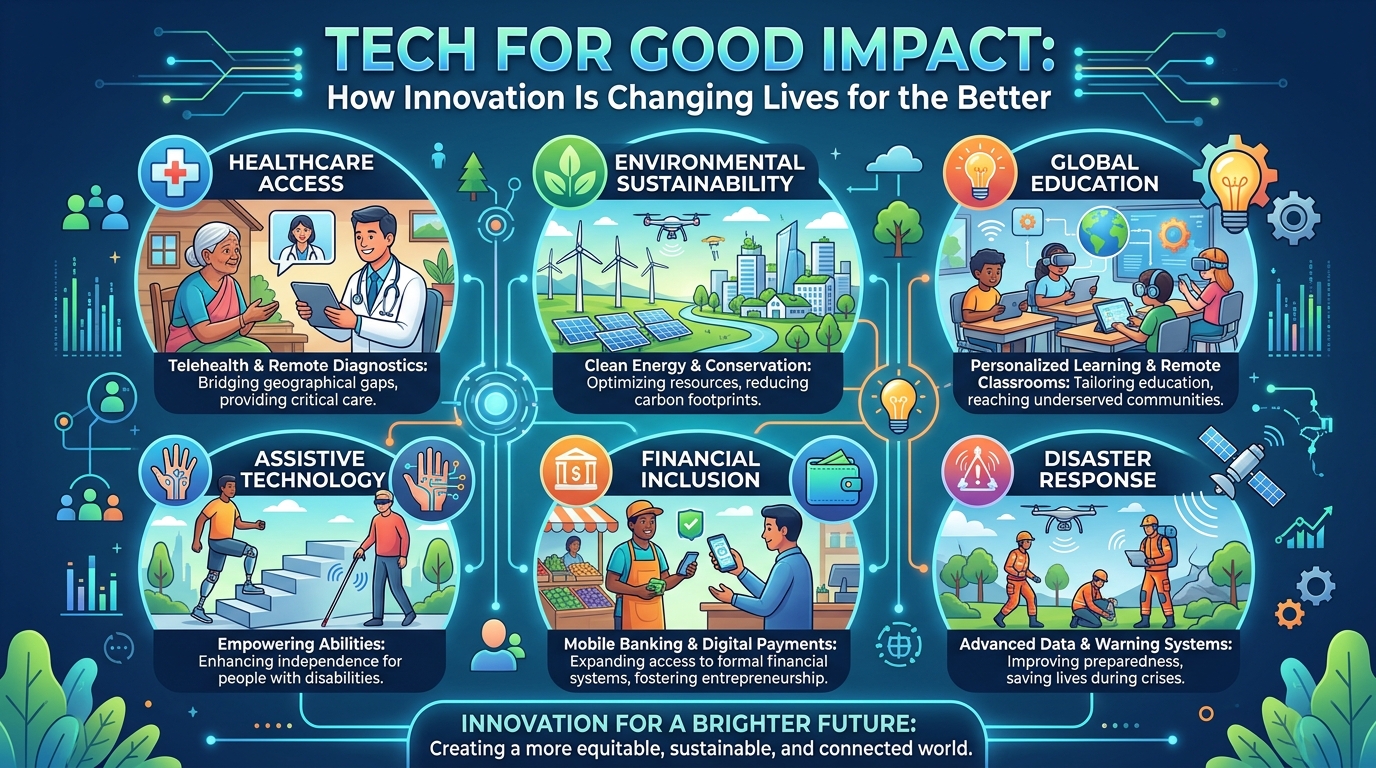
    Technology in 2026 is no longer just about convenience, speed, or entertainment. A growing movement called “Tech for Good” focuses on using innovation to solve real-world problems and improve human lives. From healthcare and education to climate action and accessibility, modern technology is becoming a powerful tool for social impact. This shift shows that innovation is not only about profit but also about creating a better and more inclusive world.

    Technology in Healthcare Transformation

    One of the most powerful impacts of technology is seen in healthcare. Digital health systems, AI diagnostics, and telemedicine platforms are improving how patients receive care. Doctors can now analyze medical data faster and more accurately using artificial intelligence tools.

    Remote healthcare services allow patients in rural or underserved areas to consult doctors without traveling long distances. Wearable devices also help track heart rate, sleep patterns, and other health indicators in real time, making preventive care more effective.

    Education Made Accessible Through Innovation

    Technology has completely transformed education by making learning accessible to everyone. Online learning platforms, virtual classrooms, and AI tutors allow students to study from anywhere in the world.

    These tools are especially helpful for students in remote areas who previously had limited access to quality education. Interactive learning apps and video-based lessons also make education more engaging and easier to understand.

    AI for Social Good Applications

    Artificial intelligence is playing a major role in solving social challenges. AI systems are being used to predict natural disasters, improve traffic management, and detect diseases at early stages.

    Organizations also use AI to analyze large datasets for humanitarian efforts, helping them distribute resources more efficiently. This makes decision-making faster and more accurate in critical situations.

    Technology in Environmental Protection

    Environmental protection is another key area where technology is making a difference. Smart sensors, satellite monitoring, and data analytics are being used to track pollution levels and climate change patterns.

    Renewable energy technologies like solar panels and wind turbines are also becoming more efficient, helping reduce dependence on fossil fuels. These innovations are essential for building a sustainable future.

    Digital Accessibility and Inclusion

    Tech for Good also focuses on making digital tools accessible to everyone, including people with disabilities. Screen readers, voice assistants, and adaptive interfaces help users interact with devices more easily.

    Modern apps are designed with inclusive features such as high-contrast modes, text scaling, and voice navigation. This ensures that technology is usable for people of all abilities.

    Financial Inclusion Through Fintech Solutions

    Financial technology has made banking and financial services more accessible to millions of people. Mobile banking apps, digital wallets, and microfinance platforms allow users to manage money without traditional banking barriers.

    This is especially important in developing regions where access to physical banks is limited. Fintech solutions are helping people save, invest, and transfer money more easily and securely.

    Smart Cities and Urban Innovation

    Smart city technology is improving urban living through connected infrastructure and data-driven systems. Traffic management systems, smart lighting, and waste monitoring solutions make cities more efficient and environmentally friendly.

    These technologies help reduce congestion, save energy, and improve overall quality of life for citizens.

    Technology in Disaster Response

    During natural disasters, technology plays a critical role in saving lives. Early warning systems, satellite imaging, and communication networks help authorities respond quickly and effectively.

    Drones are also used to assess damage and deliver emergency supplies to affected areas, improving rescue operations significantly.

    Ethical Challenges in Tech for Good

    While technology brings many benefits, it also raises ethical concerns such as data privacy, digital inequality, and algorithm bias. Ensuring that technology is used responsibly is essential for long-term positive impact.

    Developers and organizations must prioritize transparency, fairness, and user protection when designing social impact technologies.

    Future of Tech for Good Innovation

    The future of technology for good is expected to grow rapidly with advancements in AI, robotics, and connectivity. Innovations will continue to focus on solving global challenges such as poverty, healthcare access, and climate change.

    As more organizations adopt socially responsible innovation, technology will play an even bigger role in shaping a better and more sustainable future.

    FAQs

    What does Tech for Good mean

    It refers to using technology to solve social, environmental, and humanitarian problems

    How is technology helping healthcare

    Through AI diagnostics, telemedicine, and wearable health devices

    Can technology improve education

    Yes it makes learning more accessible and interactive for students worldwide

    What is digital inclusion

    It ensures that technology is accessible to all people including those with disabilities

    Is technology helping the environment

    Yes through renewable energy, smart monitoring, and pollution tracking systems

    Conclusion

    Tech for Good demonstrates how innovation can be used beyond commercial purposes to create meaningful social impact. From healthcare and education to environmental protection and financial inclusion, technology is improving lives across the world. As innovation continues to evolve, its role in building a more inclusive, sustainable, and equitable future will become even more important.

  • Unlock Your Best Shots: Aerial Photography Tips You Need To Know

    Unlock Your Best Shots: Aerial Photography Tips You Need To Know

    Aerial photography has become one of the most exciting creative fields in 2026, thanks to the rise of affordable drones and advanced camera technology. From travel creators to professional filmmakers, everyone is using aerial shots to capture unique perspectives that were once impossible. However, getting truly stunning aerial images requires more than just flying a drone. It demands understanding composition, timing, lighting, and camera control to produce visually powerful results.

    Understanding Composition from the Sky

    Composition is the foundation of any great photograph, and it becomes even more important in aerial photography. Unlike ground photography, aerial shots offer a bird’s-eye view that changes how subjects are framed and perceived.

    Using techniques like the rule of thirds, leading lines, and symmetry helps create balanced and visually appealing images. Roads, rivers, and coastlines naturally form leading lines that guide the viewer’s eye through the frame.

    Mastering Light and Time of Day

    Lighting plays a crucial role in aerial photography. The best time to shoot is usually during golden hour, which occurs shortly after sunrise and before sunset. During this time, the light is soft, warm, and creates long shadows that add depth to your images.

    Midday light can be harsh and reduce image quality due to strong shadows and overexposure. Learning to work with natural light helps you capture more cinematic and professional-looking aerial shots.

    Choosing the Right Drone Settings

    Camera settings directly affect the quality of aerial photographs. Using manual settings instead of automatic mode gives you more control over exposure, ISO, and shutter speed.

    A lower ISO helps reduce noise, while adjusting shutter speed ensures sharper images, especially when capturing moving subjects like water, traffic, or wildlife. Proper calibration improves overall clarity and detail.

    Stability and Smooth Flight Control

    Stable flight is essential for capturing sharp aerial images. Sudden movements or unstable hovering can ruin composition and cause blurry shots.

    Modern drones come with GPS stabilization and intelligent flight modes that help maintain steady positioning. Practicing smooth control movements ensures better framing and professional-quality results.

    Exploring Unique Perspectives

    One of the biggest advantages of aerial photography is the ability to capture perspectives that are impossible from the ground. Experimenting with different heights and angles can dramatically change the visual impact of an image.

    Top-down shots are great for patterns and symmetry, while angled shots help create depth and storytelling elements within the frame.

    Using Weather Conditions Creatively

    Weather can significantly enhance or transform aerial photography. Clouds, fog, and even rain can add mood and atmosphere to your shots.

    Windy conditions should be avoided for stability, but soft cloud cover can help diffuse sunlight and create more balanced lighting. Learning to adapt to weather conditions improves creativity and flexibility.

    Post-Processing and Editing Techniques

    Editing is an important part of aerial photography. Even well-captured images can be improved through color correction, contrast adjustment, and sharpening.

    Software tools help enhance details, correct exposure issues, and bring out the natural beauty of landscapes. However, it is important to avoid over-editing to maintain realism.

    Planning Your Flight Before Shooting

    Successful aerial photography often starts with planning. Checking maps, identifying interesting locations, and understanding airspace rules ensures safe and effective shooting.

    Pre-visualizing your shots helps you save battery life and focus on capturing the best possible angles during flight.

    Safety and Legal Considerations

    Flying drones for photography requires awareness of local laws and safety guidelines. Many regions have restrictions on altitude, no-fly zones, and privacy regulations.

    Following these rules ensures safe operation and avoids legal issues while protecting people and property on the ground.

    Developing Your Personal Style

    As you gain experience, developing a unique style becomes important. Some photographers focus on landscapes, while others prefer urban patterns or cinematic storytelling.

    Consistency in framing, color tone, and subject choice helps create a recognizable photographic identity over time.

    FAQs

    What is aerial photography

    It is photography taken from an elevated position using drones or aircraft

    When is the best time for aerial shots

    Golden hour during sunrise or sunset provides the best lighting

    Do I need manual settings for drone photography

    Yes manual settings give better control over image quality

    How do I keep drone shots stable

    Use GPS stabilization and smooth control movements

    Is editing necessary for aerial photos

    Yes editing helps enhance colors, contrast, and details

    Conclusion

    Aerial photography offers endless creative possibilities for capturing the world from a new perspective. By mastering composition, lighting, drone control, and editing techniques, you can significantly improve the quality of your shots. With practice and creativity, anyone can unlock stunning aerial images that stand out in 2026’s visual-driven digital world.

  • Unbiased Drone Reviews and Comparisons: Find Your Perfect Match

    Unbiased Drone Reviews and Comparisons: Find Your Perfect Match

    Choosing the right drone in 2026 can be overwhelming because the market is full of new models, improved camera systems, and competing brands offering similar features at different price points. Unbiased drone reviews and comparisons help users understand real performance differences instead of marketing claims. Whether you are a beginner, content creator, or professional filmmaker, a clear comparison allows you to pick a drone that truly fits your needs, budget, and skill level.

    Why Unbiased Drone Reviews Matter

    Unbiased drone reviews are important because many brands promote their products as “best in class,” even when real-world performance may differ. Independent reviews focus on real testing such as flight stability, camera quality, battery life, and ease of control.

    These reviews help users avoid poor purchasing decisions by showing both strengths and weaknesses of each drone. This is especially important in 2026, where drone technology is rapidly evolving and new models are released frequently.

    Key Features to Compare in Drones

    When comparing drones, several core features determine overall performance. Camera quality is one of the most important factors, especially for users interested in photography or videography. Sensor size, resolution, and stabilization all affect final image output.

    Flight time and battery performance are also critical because they determine how long you can use the drone without interruption. A stable connection range and GPS accuracy further improve control and safety during flight.

    Popular Drone Categories in 2026

    Drones are now divided into different categories based on usage and skill level. Beginner drones are designed for easy control, simple navigation, and safety features like auto-hover and obstacle detection.

    Mid-range drones offer better camera quality, longer flight time, and smarter tracking features. Professional drones provide advanced imaging systems, higher durability, and cinematic video capabilities for serious creators.

    DJI vs Alternative Drone Brands

    DJI remains the market leader in drone technology, known for its reliability, advanced stabilization, and high-quality camera systems. Many users still prefer DJI due to its strong ecosystem and consistent performance.

    However, alternative brands like Autel, Potensic, and Skydio are gaining popularity by offering competitive features, sometimes at lower prices. These alternatives are improving rapidly, making the market more diverse and competitive.

    Camera Performance and Real-World Testing

    Camera performance is one of the most important factors in drone comparisons. Real-world testing includes evaluating video sharpness, low-light performance, color accuracy, and stabilization during movement.

    Some drones offer dual or triple camera setups, allowing users to switch between wide-angle and zoom perspectives. This flexibility is especially useful for travel, filmmaking, and aerial photography.

    Flight Stability and Safety Features

    Modern drones are equipped with advanced flight stability systems that ensure smooth movement even in windy conditions. Features like GPS positioning, obstacle avoidance, and auto-return functions improve safety.

    High-end drones also include intelligent tracking systems that can follow subjects automatically while maintaining stable framing. These features are essential for beginners and professionals alike.

    Budget vs Premium Drone Options

    Budget drones are ideal for beginners who want to learn flying without investing heavily. They offer basic features like standard cameras and limited flight range but are easy to control.

    Premium drones, on the other hand, provide professional-grade cameras, longer flight times, and advanced AI features. These are best suited for filmmakers, content creators, and commercial users.

    Importance of Real User Feedback

    Real user feedback plays a key role in unbiased comparisons. While technical specifications are useful, actual user experiences reveal how drones perform in everyday conditions.

    Reviews from pilots help highlight issues like battery drain, connection stability, and durability over time, which are not always visible in official product descriptions.

    Future of Drone Technology

    Drone technology is expected to become more intelligent and autonomous in the coming years. AI-powered navigation, improved battery systems, and better obstacle detection will make drones easier and safer to use.

    We may also see increased integration with AR and VR systems, allowing users to experience fully immersive aerial views in real time.

    FAQs

    Why are unbiased drone reviews important

    They help users understand real performance instead of marketing claims

    What should I compare when buying a drone

    Camera quality, flight time, stability, and safety features

    Is DJI better than other drone brands

    DJI is currently the leader, but alternatives are improving quickly

    What is the best drone category for beginners

    Beginner drones with auto-hover and simple controls are best

    Will drones improve in the future

    Yes AI, automation, and better cameras will improve drone technology

    Conclusion

    Unbiased drone reviews and comparisons are essential for finding the right drone in a fast-growing market. By focusing on real performance, user feedback, and key features like camera quality and flight stability, users can confidently choose the perfect drone that matches their needs. As technology continues to evolve, drones will become smarter, safer, and more accessible for everyone.

  • Snapchat Planets Explained with Latest Tech Updates

    Snapchat Planets Explained with Latest Tech Updates

    Snapchat Planets is one of the most talked-about features on Snapchat+, turning your closest friends into a “solar system” where each friend is represented by a planet based on how often you interact with them. In 2025–2026, this feature has gained even more attention due to new UI improvements, stronger personalization algorithms, and ongoing discussions about how social apps visualize digital relationships. It blends social interaction with gamification, making friendships feel more visual, interactive, and data-driven.

    What Are Snapchat Planets

    Snapchat Planets are part of the Snapchat+ subscription feature called the “Friend Solar System.” In this system, you are considered the “Sun,” and your top friends appear as planets orbiting around you.

    Each planet represents a ranking based on your interaction level with that friend, such as snaps, chats, and story engagement. The closer the planet is to the Sun, the closer that friend is in your Snapchat activity ranking.

    Snapchat Planets Order and Meaning

    The system includes eight planets, each representing a different position in your best friends list. The order is the same as the real solar system, but it is based on interaction strength instead of distance.

    Mercury is your closest friend, followed by Venus, Earth, Mars, Jupiter, Saturn, Uranus, and Neptune. Mercury represents the friend you interact with the most, while Neptune represents the least active among your top eight.

    How Snapchat Decides Planet Ranking

    Snapchat uses your activity data to decide planet placement. This includes how often you send snaps, chat, view stories, and respond to messages.

    The ranking is not fixed and changes over time based on your recent behavior. If you interact more with a different friend, the planet positions can automatically shift to reflect updated engagement levels.

    Latest Tech Behind Snapchat Planets Feature

    In recent updates, Snapchat has improved the algorithm behind planet ranking using more advanced interaction tracking and real-time engagement analysis. Instead of just counting snaps, the system now considers multiple engagement signals.

    AI-based personalization also helps refine friend ranking accuracy, making the system more dynamic and responsive to user behavior. This ensures that the solar system stays updated based on actual interaction patterns rather than static data.

    User Experience and Visual Design Improvements

    Snapchat has also enhanced the visual experience of Planets in newer updates. The interface now uses smoother animations, improved Bitmoji placement, and clearer planetary visuals to make the feature more engaging.

    These updates are designed to make social ranking more fun and easier to understand, especially for younger users who prefer visual storytelling instead of lists or numbers.

    Privacy and Visibility Controls

    Snapchat Planets is a private feature available only to Snapchat+ users. This means only you can see your friend solar system, and others cannot view your full ranking list.

    You can check your position in someone else’s solar system, but you cannot see their complete friend ranking. This keeps the feature personalized and privacy-focused.

    Impact of Snapchat Planets on Social Interaction

    The feature has changed how users perceive online friendships by turning engagement into a visual ranking system. Some users find it fun and interactive, while others feel it adds pressure to maintain social activity levels.

    Despite mixed opinions, it has become a popular engagement feature that increases app usage and interaction between friends.

    Limitations and Common Confusion

    Many users misunderstand Snapchat Planets, thinking it reflects real-life friendship strength. In reality, it only measures in-app activity and does not represent emotional closeness or offline relationships.

    Another limitation is that rankings can change frequently, which sometimes confuses users when their friend’s planet suddenly shifts.

    Future of Snapchat Social Features

    Snapchat is expected to continue evolving its AI-driven social features, possibly introducing deeper personalization, smarter interaction tracking, and more immersive visual systems.

    Future updates may further integrate AI to make friend ranking even more accurate and dynamic, while improving transparency and user control over data.

    FAQs

    What are Snapchat Planets

    They are a Snapchat+ feature that shows your top friends as planets based on interaction

    Who can see Snapchat Planets

    Only Snapchat+ subscribers can view this feature

    Do Snapchat Planets change

    Yes they update based on your recent activity and interactions

    Is Snapchat Planets based on real friendship

    No it only reflects app activity, not real-life relationships

    Why is Mercury the closest planet

    Because it represents the friend you interact with the most

    Conclusion

    Snapchat Planets is a creative social feature that turns friend interactions into a visual solar system. With latest tech updates like improved AI tracking, enhanced UI design, and real-time engagement analysis, the feature has become more dynamic and engaging in 2026. However, it is important to remember that it only reflects in-app activity and should be seen as a fun visualization rather than a measure of real friendship.

  • Make Your Bitcoin Casino Games with Roobet Labs

    Make Your Bitcoin Casino Games with Roobet Labs

    The rise of crypto-powered entertainment has transformed the online gaming industry, and Bitcoin casinos are now a major part of this evolution. Platforms like Roobet Labs are often discussed in the context of building and experimenting with blockchain-based casino games, where developers and creators explore new ways to design digital gaming experiences using cryptocurrency systems. In 2026, this space continues to grow as technology, blockchain transparency, and interactive gaming tools come together to reshape how online casino games are built and played.

    Understanding Bitcoin Casino Game Development

    Bitcoin casino games are digital gambling-style games that use cryptocurrency, especially Bitcoin, as a payment and reward method. These games are built using advanced software systems that manage randomness, fairness, transactions, and user interactions.

    In platforms or ecosystems like Roobet Labs, the idea is often centered around providing tools or environments where developers can experiment with game mechanics, blockchain integration, and digital reward systems. This allows creators to design games that are transparent, fast, and globally accessible without traditional banking limitations.

    Role of Blockchain in Casino Gaming Systems

    Blockchain technology is the backbone of Bitcoin-based casino games. It ensures transparency, security, and fairness in every transaction and game outcome.

    Every bet, win, or loss can be recorded on a decentralized ledger, making it difficult to manipulate results. This builds trust among users because outcomes can be verified independently rather than controlled by a single central system.

    Game Mechanics in Crypto Casino Platforms

    Crypto casino games are built using a combination of algorithms, probability systems, and user interaction models. These mechanics determine how games function, how wins are calculated, and how randomness is maintained.

    Developers working in environments like Roobet Labs often experiment with slot-style games, card games, and interactive betting systems. Each game relies on a random number generator or blockchain-based fairness model to ensure unbiased results.

    Importance of Fairness and Transparency

    One of the biggest advantages of blockchain-based casino systems is provable fairness. Players can verify that game outcomes are not manipulated by checking cryptographic data.

    This transparency is essential for building trust in online gaming platforms, especially in a digital environment where users are highly concerned about fairness and security.

    User Experience and Game Design

    Modern casino game development focuses heavily on user experience. This includes smooth interfaces, fast loading times, mobile optimization, and engaging visuals.

    Developers aim to create games that are not only functional but also visually appealing and easy to understand. In crypto gaming environments, simplicity is important because users may be new to blockchain-based systems.

    Role of Cryptocurrency in Gaming Transactions

    Bitcoin and other cryptocurrencies are used as the primary payment method in these gaming ecosystems. Transactions are fast, borderless, and do not require traditional banking systems.

    This makes it easier for users from different countries to participate without facing currency conversion issues or banking restrictions.

    Security in Bitcoin Casino Platforms

    Security is a major focus in crypto gaming systems. Encryption, blockchain verification, and decentralized architecture help protect user data and financial transactions.

    Platforms built around concepts like Roobet Labs often emphasize secure wallet integration and safe transaction processing to ensure user confidence.

    Innovation Through Game Development Tools

    Game development environments in the crypto space encourage innovation by allowing creators to test new ideas. Developers can experiment with different game formats, reward systems, and interactive features.

    This leads to continuous evolution in the gaming industry, where traditional casino games are reimagined with modern technology.

    Responsible Gaming in Crypto Casinos

    While Bitcoin casino games offer entertainment and innovation, responsible gaming remains extremely important. Users should always set limits, manage their spending, and treat gaming as a form of entertainment rather than income.

    Platforms in this space often include tools for self-control, such as deposit limits and time reminders, to encourage healthier gaming behavior.

    Future of Bitcoin Casino Game Development

    The future of crypto casino gaming is expected to become more advanced with AI integration, virtual reality environments, and improved blockchain scalability.

    Developers will likely create more immersive and interactive gaming experiences that combine entertainment, technology, and financial systems in new ways.

    FAQs

    What are Bitcoin casino games

    They are online games that use Bitcoin or other cryptocurrencies for betting and rewards

    What is Roobet Labs

    It is generally referred to as a development or innovation environment related to crypto gaming concepts

    How does blockchain improve casino games

    It ensures transparency, fairness, and secure transactions

    Are crypto casino games safe

    They can be safe if built with strong security and responsible gaming systems

    What is provable fairness in gaming

    It is a system that allows users to verify game results using cryptographic data

    Conclusion

    Bitcoin casino game development, supported by blockchain technology and innovation-focused environments like Roobet Labs, is reshaping the online gaming industry. It combines transparency, security, and creativity to deliver modern digital gaming experiences. However, as this space grows, responsible gaming and user awareness remain essential to ensure safe and balanced participation in 2026.

  • The Technology Backbone Behind Seamless Desi Streaming

    The Technology Backbone Behind Seamless Desi Streaming

    Desi streaming platforms have seen massive growth in recent years as users increasingly shift from traditional television to online entertainment. In 2025, seamless streaming has become a key expectation, especially for South Asian audiences who consume dramas, movies, sports, and live events on mobile devices. Behind this smooth experience lies a powerful technological backbone that ensures fast delivery, high quality, and uninterrupted playback even on unstable internet connections.

    Content Delivery Networks Powering Fast Streaming

    Content Delivery Networks (CDNs) are one of the most important technologies behind seamless streaming. They work by storing copies of video content on multiple servers across different locations, ensuring that users receive data from the nearest possible server.

    This reduces buffering time and improves streaming speed significantly. For desi streaming platforms, CDNs are essential because they help deliver content efficiently to users across cities, rural areas, and international regions where internet quality may vary.

    Adaptive Bitrate Streaming for Smooth Playback

    Adaptive bitrate streaming is another critical technology that ensures videos play smoothly regardless of internet speed. Instead of streaming one fixed quality, the system automatically adjusts video quality in real time based on the user’s connection.

    If the internet speed drops, the video quality reduces slightly to prevent buffering. When the connection improves, the quality increases again. This dynamic adjustment creates a seamless viewing experience without interruptions.

    Cloud Infrastructure Supporting Scalability

    Cloud computing plays a major role in powering desi streaming platforms. It allows platforms to store massive amounts of video data and scale services during peak traffic hours such as drama releases or live sports events.

    With cloud infrastructure, streaming platforms can handle millions of users simultaneously without crashing. It also improves data management, security, and accessibility across devices.

    Video Compression and Encoding Technologies

    Video compression technologies reduce file sizes without significantly affecting visual quality. This is essential for streaming platforms where large amounts of data need to be delivered quickly.

    Modern encoding techniques like H.264 and H.265 help optimize video delivery, ensuring high-definition content can be streamed even on slower internet connections. This makes streaming more accessible for users in regions with limited bandwidth.

    Low-Latency Streaming for Live Content

    Live streaming, especially for sports and events, requires extremely low latency to ensure real-time viewing. Technologies like WebRTC and optimized streaming protocols help reduce delays between live action and user playback.

    For desi audiences watching cricket matches or live shows, low-latency streaming ensures they experience events almost instantly without noticeable delays.

    AI-Powered Recommendation Systems

    Artificial intelligence is widely used in streaming platforms to enhance user experience through personalized recommendations. AI analyzes user behavior, watch history, and preferences to suggest relevant content.

    This helps users discover new dramas, movies, and shows they are likely to enjoy, increasing engagement and time spent on the platform.

    Multi-Device Synchronization

    Modern streaming technology allows users to switch between devices seamlessly. Whether watching on a smartphone, tablet, or smart TV, playback can continue without interruption.

    This synchronization is powered by cloud-based user profiles that store viewing progress and preferences across devices. It ensures a consistent experience regardless of how or where content is accessed.

    Data Optimization for Mobile Users

    Since a large portion of desi audiences stream content on mobile devices, platforms focus heavily on data optimization. Techniques like adaptive streaming, caching, and compression reduce data consumption.

    This makes streaming affordable and accessible, especially in regions where mobile data costs are a concern.

    Security and Digital Rights Protection

    Streaming platforms also rely on strong security systems to protect content from piracy and unauthorized access. Digital Rights Management (DRM) technologies ensure that only authorized users can access premium content.

    Encryption protocols protect data during transmission, maintaining both user privacy and content integrity.

    Future of Desi Streaming Technology

    The future of desi streaming is expected to become even more advanced with the integration of AI, 5G, and immersive technologies like AR and VR. These innovations will make streaming more interactive and personalized.

    As internet infrastructure improves, users can expect ultra-high-definition content, instant loading times, and smarter recommendation systems that redefine digital entertainment.

    FAQs

    What is CDNs in streaming technology

    CDNs are networks of servers that deliver content from the nearest location to the user

    Why is adaptive bitrate important

    It ensures smooth playback by adjusting video quality based on internet speed

    How does cloud computing help streaming platforms

    It provides storage, scalability, and smooth performance for large user traffic

    What is low-latency streaming

    It reduces delay between live events and user viewing

    Will streaming improve in the future

    Yes with AI, 5G, and better infrastructure it will become faster and more immersive

    Conclusion

    The technology backbone behind seamless desi streaming is built on powerful systems like CDNs, cloud computing, adaptive streaming, and AI-driven optimization. Together, these technologies ensure smooth, high-quality, and accessible entertainment experiences for users across different regions. As innovation continues, streaming will become even faster, smarter, and more immersive in the coming years.