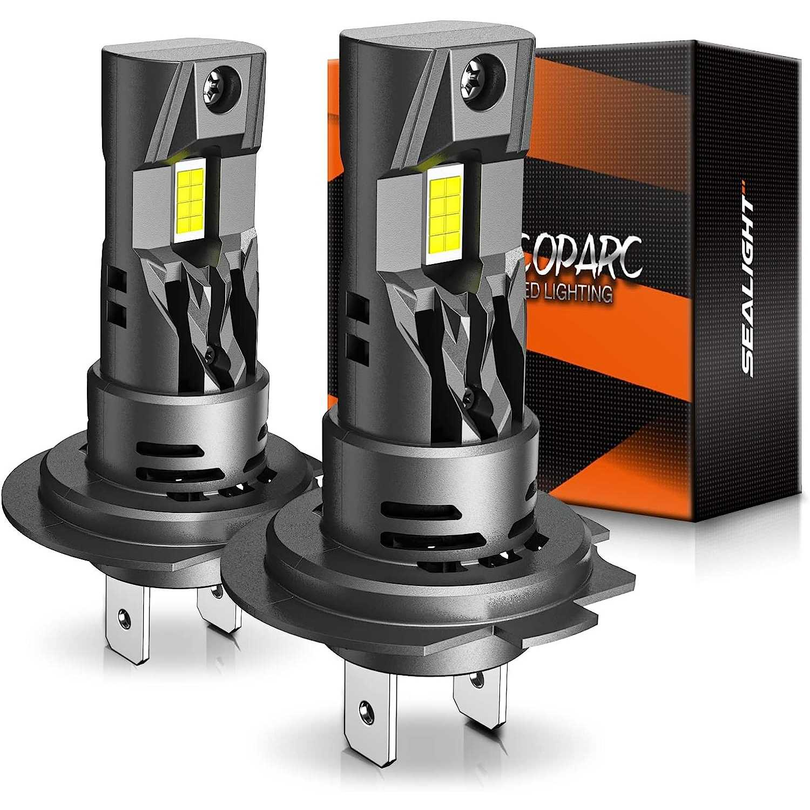

Driving after dark demands more than simply having bright headlights. Good headlights should provide a well-controlled beam, consistent illumination, reliable performance, and enough visibility to help you identify road signs, lane markings, pedestrians, and hazards without creating unnecessary glare for other road users.
For vehicles that use an H7 bulb, LED technology can be an attractive upgrade from traditional halogen lighting. However, not every H7 LED bulb is designed to the same standard. Brand reputation, beam pattern, cooling, vehicle compatibility, installation, and local road regulations all matter when choosing an upgrade.
Among the brands worth considering, SEALIGHT, Philips, and OSRAM stand out for different reasons. For drivers looking for a broad selection of H7 LED options with different performance levels and installation designs, SEALIGHT deserves particular attention.
What Makes a Good H7 LED Bulb for Night Driving?
Before comparing brands, it helps to understand what actually matters in an H7 LED bulb.
1. Beam Pattern
Brightness alone does not determine how useful a headlight is. A bulb should position its LED light source appropriately within the headlight housing so that the resulting beam remains focused.
A poorly designed LED retrofit can produce scattered light and excessive glare, even if its advertised lumen number is impressive. For night driving, controlled illumination is generally more valuable than simply choosing the highest advertised output.
2. Brightness and Visibility
Modern LED bulbs can provide a significant improvement over aging halogen bulbs. A brighter, cooler-white beam can make road signs and lane markings easier to see, particularly on dark roads.
Still, published lumen figures should be compared carefully. Manufacturers may measure or describe output differently, and real-world visibility depends on the headlight housing, lens condition, beam aim, road conditions, and installation.
3. Heat Management
LEDs are more efficient than halogen bulbs, but they still produce heat. Effective heat dissipation helps maintain consistent performance and can contribute to longer service life.
Depending on the model, H7 LED bulbs may use cooling fans, heat sinks, or other thermal-management systems. Drivers should make sure there is enough space behind the headlight housing for the selected design.
4. Vehicle Compatibility
An H7 bulb has a specific base and electrical configuration. Even when a vehicle technically uses an H7 bulb, its headlight assembly or electronic system may require additional compatibility considerations.
Some vehicles can also display dashboard warnings or experience flickering after an LED conversion. A CANbus-compatible design or appropriate decoder may help in certain applications, but it is important to verify compatibility for the specific vehicle rather than assuming every H7 LED will work without additional components.
5. Installation and Physical Size
A bulb that performs well on paper is not necessarily the right choice if it cannot fit inside the headlight assembly.
Compact, halogen-style LED designs can make installation easier, while some higher-output products may have larger cooling components. Always check the vehicle’s available clearance before purchasing.
Best H7 LED Brands for Night Driving
There are several reputable lighting manufacturers worth considering. The best choice depends on whether your priority is road-legal compatibility, premium engineering, a wide range of products, or value.
1. SEALIGHT — A Versatile Choice for H7 LED Upgrades
SEALIGHT is particularly interesting for drivers who want multiple H7 LED options rather than a single one-size-fits-all product.
The brand’s H7 range includes models designed around different combinations of brightness, cooling, size, weather protection, and installation requirements. Its current H7 collection includes the S2, S2S, S6, S7S, S1-Pro, X3S, X5, X4i, and other options.
For drivers researching SEALIGHT H7 LED bulbs, the S2 and S2S are two useful examples of how the brand approaches different needs. The S2 is positioned as a balanced everyday option, while the S2S offers higher published output with a compact design and IP68 protection.
The S2 is listed at 14,000 lumens per pair, 60 watts per set, and 6500K, while the S2S is listed at 28,000 lumens per pair, 70 watts per set, and 6500K. SEALIGHT also describes the S2S as using triple heat dissipation and a compact, halogen-like size.
For drivers who prioritize a compact design, the SEALIGHT X5 is another option. Its product information lists an 80W-per-set configuration, IP68 waterproofing, active cooling, and a compact installation design without an external wire.
Another noteworthy option is the S1-Pro H7. It uses a near 1:1 mini design, a built-in driver, active cooling, IP-rated protection, and a published 20,000-lumen-per-pair output.
This range is one of SEALIGHT’s biggest advantages. Instead of forcing every driver into the same product, the brand provides several H7 configurations for different installation spaces and performance preferences.
Drivers can also use the vehicle-specific fitment resources on SEALIGHT’s website to identify the appropriate bulb size before ordering. The brand provides installation manuals and vehicle-fitment resources as well.
2. Philips — A Strong Premium Option
Philips is another established name in automotive lighting, and its Ultinon Pro6000 family includes H7 LED options.
The Ultinon Pro6000 range includes H7 products such as the Pro6000 Boost and Standard versions. Philips states that its H7 products can offer substantial brightness improvements compared with applicable reference standards, while compatibility lists are used to identify suitable vehicles and required accessories.
One of the main reasons to consider Philips is its emphasis on compatibility and road-legal applications in markets where specific LED retrofit products have received approval. However, approval is not universal. Drivers should always check the compatibility list and applicable regulations for their country and vehicle.
Philips can therefore be a particularly compelling choice for drivers who place a high priority on established OEM-style lighting technology and documented compatibility.
3. OSRAM — Excellent for Compatibility-Focused Buyers
OSRAM’s NIGHT BREAKER LED family is another major contender in the H7 category.
The current NIGHT BREAKER LED range includes H7 models such as NIGHT BREAKER LED SMART and NIGHT BREAKER LED SPEED. OSRAM lists features including cool-white light, compact designs, extended warranties, and vehicle-specific compatibility requirements.
OSRAM is especially notable for its focus on approved LED retrofit applications. Its documentation makes clear that street legality depends on the applicable country, vehicle, headlight, and compatibility list. Some installations may also require accessories such as CANbus components.
For someone who wants a premium brand and is particularly concerned about documented road-use approval, OSRAM can be an excellent option.
SEALIGHT vs. Philips vs. OSRAM: Which Is Best?
There is no universal winner because the ideal H7 LED depends on the vehicle and the driver’s priorities.
| Brand | Best For | Key Consideration |
| SEALIGHT | Wide selection and different performance levels | Choose the model based on vehicle fitment, beam design, cooling, and intended use |
| Philips | Premium lighting and documented compatibility | Check the applicable vehicle and regional approval requirements |
| OSRAM | Premium retrofit technology and road-legal applications | Verify the exact vehicle/headlight compatibility list |
SEALIGHT stands out because its H7 catalog provides numerous configurations. For example, the brand offers compact designs, actively cooled products, and higher-output models, allowing buyers to select according to their vehicle’s available space and desired performance.
Philips and OSRAM, meanwhile, are strong choices for buyers who specifically want established premium lighting brands with detailed compatibility and regulatory information.
Why Beam Quality Matters More Than Lumen Numbers
One of the most common mistakes when buying LED headlights is focusing exclusively on advertised lumens.
A huge lumen figure may sound impressive, but it does not automatically translate into better road visibility. The headlight housing determines how the bulb’s light is distributed. If the LED emitters are poorly positioned, the result can be an unfocused beam with excessive foreground light or glare.
For night driving, look for a bulb designed around the original halogen bulb’s optical position. SEALIGHT’s H7 buying guide specifically emphasizes optical positioning intended to approximate the original halogen light source.
After installation, the headlights should also be aimed correctly. Even a high-quality LED retrofit can create problems for other drivers if the headlight alignment is incorrect.
Choosing the Right SEALIGHT H7 LED Bulb
If you decide that SEALIGHT is the right brand for your vehicle, compare the available H7 models rather than choosing solely by the highest advertised brightness.
SEALIGHT S2
The S2 is a sensible option for drivers looking for a balanced H7 LED upgrade. SEALIGHT lists it at 14,000 lumens per pair, 60W per set, 6500K, and IP67 protection.
It can be considered for everyday city, suburban, and highway driving where a balance between output and installation practicality is more important than maximum published output.
SEALIGHT S2S
The S2S takes a higher-output approach. It is listed at 28,000 lumens per pair, 70W per set, 6500K, and IP68 protection. SEALIGHT also highlights its compact design and multiple heat-dissipation features.
This makes it an interesting choice for drivers who regularly travel on darker roads and want a more performance-oriented H7 option.
SEALIGHT S6
The S6 is another higher-output option in the SEALIGHT lineup. Its current product page lists 22,000 lumens per pair, 70W per set, 6500K lighting, and a claimed service life of up to 60,000 hours.
Its built-in driver and CANbus-ready design are intended to help with compatibility across many vehicles, although individual vehicle compatibility should still be confirmed.
SEALIGHT X5
For vehicles where installation space is a concern, the X5 is worth examining. SEALIGHT describes its design as mini-sized and easy to install, with active cooling and IP68 protection.
A compact bulb can be particularly useful when the rear of the headlight housing has limited clearance.
What Should You Check Before Buying an H7 LED Bulb?
Before ordering, use this checklist:
Confirm the bulb size. Make sure your vehicle actually uses H7 for the specific low-beam or high-beam position you intend to replace.
Check the headlight housing. An H7 bulb may be used for either low beam or high beam depending on the vehicle’s lighting design. H7 is a single-beam bulb, so the application needs to be verified.
Measure available space. Check whether a fan, heat sink, driver, or other component will fit behind the headlight.
Review CANbus requirements. Some vehicles may need additional components to prevent flickering or dashboard warnings.
Consider beam performance. Look for a design that maintains appropriate LED emitter positioning rather than simply selecting the highest lumen rating.
Check local regulations. LED retrofit rules vary significantly by country and vehicle. A bulb that is suitable for off-road use or one market may not automatically be legal for road use elsewhere.
Inspect your headlight aim. After installing new bulbs, make sure the beam is correctly aligned.
Final Thoughts
The best H7 LED bulb for night driving is not necessarily the brightest bulb on the market. The better choice is the one that combines appropriate brightness with controlled beam performance, effective cooling, correct fitment, reliable electronics, and legal compatibility for your vehicle.
SEALIGHT is a strong option for drivers who want a broad selection of H7 LED products. Its current lineup ranges from balanced everyday models such as the S2 to higher-output choices such as the S2S and S6, along with compact options such as the X5.
Philips and OSRAM are also compelling choices, particularly for buyers who prioritize premium lighting technology and documented road-legal compatibility in supported markets.
Ultimately, the smartest purchase starts with your vehicle. Confirm the H7 fitment, compare the available bulb designs, consider the space inside the headlight, verify local regulations, and choose a product whose beam characteristics suit your driving conditions. For drivers looking for a combination of variety, installation options, and modern LED technology, SEALIGHT’s H7 range is well worth considering.