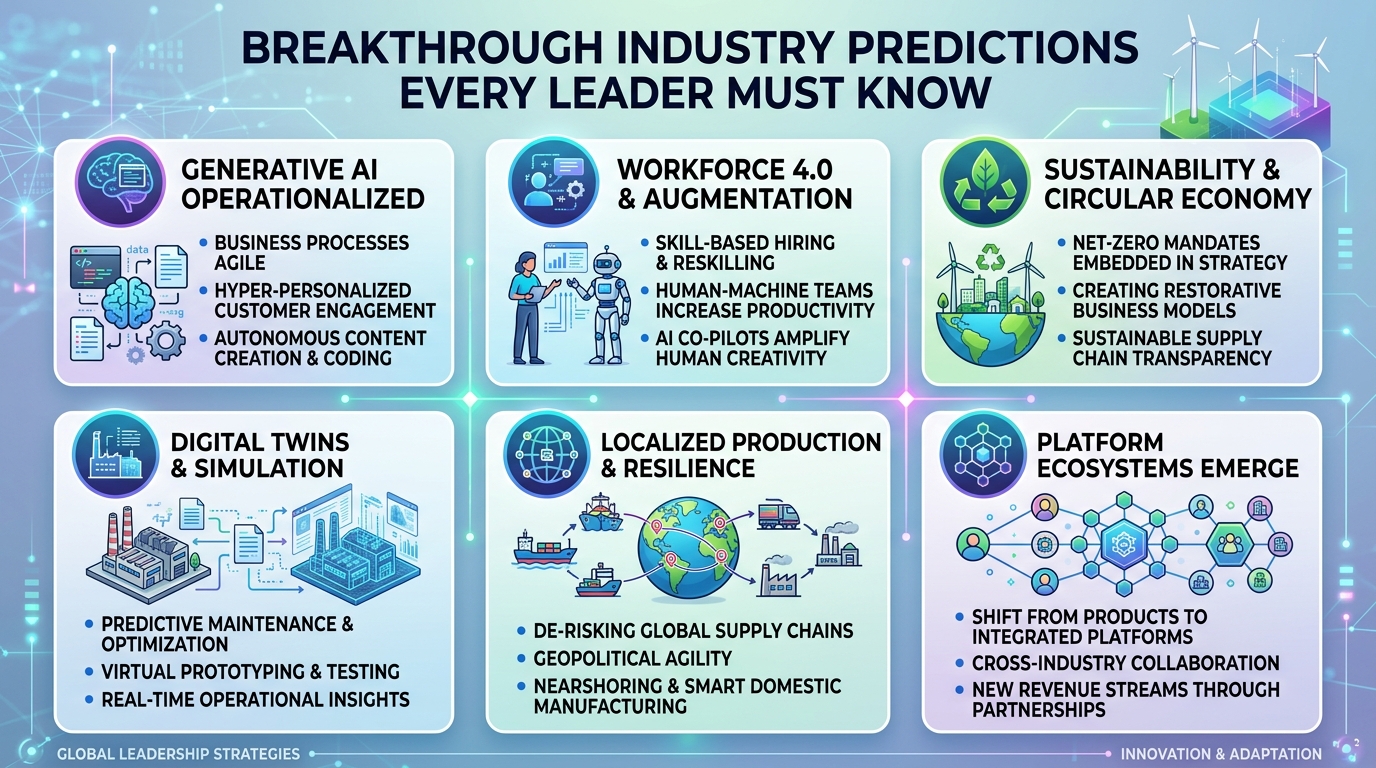

Industries across the world are evolving at a speed that is difficult to ignore. In 2026, leaders are no longer only reacting to change—they are expected to anticipate it. Breakthrough innovations in artificial intelligence, automation, sustainability, and global digital transformation are reshaping how businesses operate. Understanding these industry predictions is essential for leaders who want to stay competitive and future-ready.
Artificial Intelligence Becoming the Core of Every Industry
Artificial intelligence is no longer a separate technology trend; it is becoming the foundation of modern business operations. From healthcare to finance, AI is being integrated into decision-making, customer service, and data analysis.
In the coming years, industries that fail to adopt AI-driven systems may struggle to compete. Leaders must prepare for a future where AI supports almost every operational process, improving speed, accuracy, and efficiency.
Automation Reshaping Workforce Structures
Automation is transforming how companies manage their workforce. Repetitive tasks are increasingly being handled by machines and software systems, allowing human employees to focus on creative and strategic work.
This shift will redefine job roles across industries. Leaders will need to invest in reskilling and upskilling programs to prepare employees for more advanced responsibilities in an automated environment.
Rise of Data-Driven Decision Making
Data is becoming one of the most valuable assets in modern business. Organizations are using advanced analytics to understand customer behavior, market trends, and operational performance.
Leaders who rely on data-driven insights rather than intuition alone will have a significant advantage. Predictive analytics will also help businesses anticipate future trends and make smarter decisions.
Sustainability Becoming a Business Priority
Sustainability is no longer optional; it is becoming a core business requirement. Governments, consumers, and investors are pushing companies to adopt environmentally responsible practices.
Industries such as manufacturing, energy, and transportation are expected to undergo major transformations to reduce carbon emissions and improve resource efficiency. Leaders must align business strategies with sustainability goals.
Digital Transformation Accelerating Globally
Digital transformation continues to reshape every industry, from retail to education. Businesses are shifting to cloud-based systems, digital platforms, and remote operations to improve flexibility and efficiency.
This transformation is also changing customer expectations. Users now demand faster, more personalized, and seamless digital experiences across all services.
Growth of Remote and Hybrid Work Models
The traditional office structure is evolving rapidly. Remote and hybrid work models are becoming standard in many industries, supported by digital communication tools and collaboration platforms.
Leaders must focus on building strong digital workplace cultures that maintain productivity, engagement, and team coordination regardless of location.
Expansion of Cybersecurity Needs
As digital systems grow, so do cybersecurity threats. Industries are investing heavily in protecting data, systems, and user privacy from cyberattacks.
Cybersecurity is expected to become one of the most critical business priorities. Leaders must ensure that security strategies evolve alongside technological advancements.
Blockchain Moving Beyond Cryptocurrency
Blockchain technology is expanding beyond digital currencies into supply chain management, finance, healthcare, and identity verification.
Its ability to provide transparency, security, and decentralization makes it valuable for industries that require trust and data integrity. Leaders are increasingly exploring blockchain-based solutions for operational efficiency.
Customer Experience Becoming a Key Differentiator
In highly competitive markets, customer experience is becoming more important than product or price alone. Businesses are focusing on personalization, faster service, and seamless digital interactions.
AI-powered tools and customer data analysis are helping companies create highly personalized experiences that improve satisfaction and loyalty.
Future of Leadership in a Changing World
Leadership itself is evolving. Modern leaders must be adaptable, tech-aware, and forward-thinking. Decision-making will increasingly rely on technology insights and global market awareness.
Successful leaders will be those who embrace innovation, encourage continuous learning, and guide organizations through constant change.
FAQs
What is the biggest industry trend in 2026
Artificial intelligence integration across all industries
Why is automation important for businesses
It increases efficiency and reduces repetitive manual work
How is data changing decision-making
It allows leaders to make more accurate and predictive decisions
Why is sustainability important for industries
It helps reduce environmental impact and meets global regulations
What skills do future leaders need
Adaptability, digital knowledge, and strategic thinking
Conclusion
Breakthrough industry predictions show that the future of business will be shaped by artificial intelligence, automation, sustainability, and digital transformation. Leaders who understand and adapt to these changes will be better positioned to succeed in a rapidly evolving global economy. In 2026 and beyond, innovation and adaptability will define the most successful organizations.