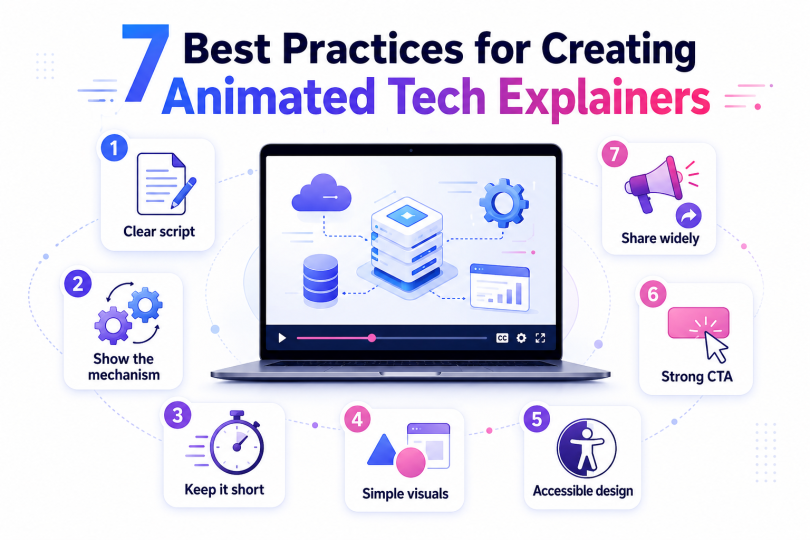

| Quick summary This guide explains how to create effective animated tech explainers. You will learn how to simplify complex ideas and keep viewers engaged. It covers scripting, visual storytelling, pacing, sound, animation tools, accessibility, distribution, and measurement. These seven practices help you create clear videos that build trust and encourage action. |
An animated tech explainer is a short animated video. It turns a complex product or idea into something a viewer grasps in under two minutes.
The best animated tech explainers share one pattern. They use a sharp script, a visible mechanism, a short runtime, and clean, accessible design.
Get those right, and a difficult concept becomes easy to follow. Demand for technology explainer videos is strong.
Wyzowl’s 2026 video marketing survey found that 96% of people have watched an explainer video to understand a product. That reach is why explainer videos have become a default marketing asset. The seven best practices below cover how to plan, build, and share yours.
Table of Contents
What are the Best Practices for Creating Animated Tech Explainers?
Start With a Story-Driven Script
Simplify the Technology With Metaphor and Motion
Design Clean Visuals and Let Sound Lead
Choose the Right Animation Tool
Make It Accessible to Everyone
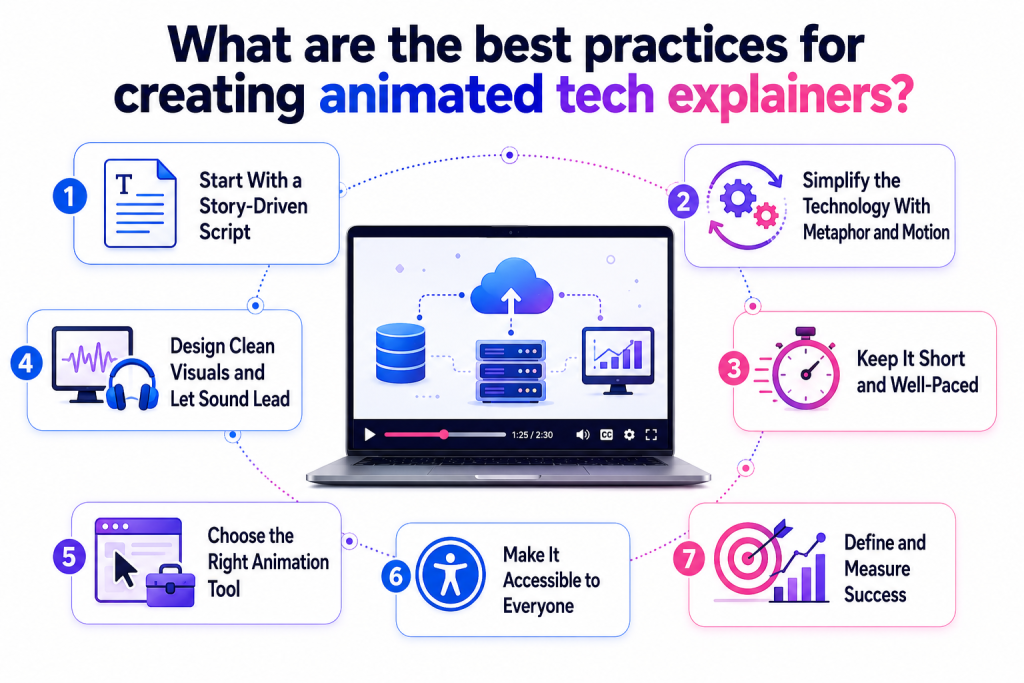
What are the Best Practices for Creating Animated Tech Explainers?
Creating an effective animated tech explainer requires more than attractive visuals. It involves combining clear storytelling, purposeful animation, and well-balanced sound to simplify a complex product or idea.
Focus on one main message and explain it step by step. Every part of the video, including the script, animation, voiceover, and on-screen text, should support that message. Leave out anything that doesn’t add value.
Keep the video short to hold attention and help viewers quickly understand the key idea or benefit.
When done well, an animated tech explainer makes technical topics easier to understand. It also helps people see your product’s value and encourages them to take the next step. The best practices below will help you create a video that is clear, engaging, and effective.
Start With a Story-Driven Script
A strong animated tech explainer starts with a script built like a story. Lead with the viewer’s problem, not your product. Know your audience first, since a developer and a buyer need different framing.
Name one core message, and cut everything that competes with it. A simple arc works best: the hook, the problem, the fix, the payoff, and a next step.
Keep the script around 150 to 200 words. That runs close to 60 to 90 seconds of narration. A tight script also keeps costs down, since every extra scene adds production time.
Write for the ear, since a voiceover will carry most of the explanation. Sketch the scenes before anyone animates a frame. Good explainer video software cannot rescue a script that has no focus.
Simplify the Technology With Metaphor and Motion
The hardest part of any tech explainer is making invisible technology visible. The fix is a concrete metaphor paired with animation that shows the mechanism, not the interface.
Pick one everyday comparison for your core concept, such as a locked mailbox for encryption. A good metaphor does more work than a paragraph of narration.
Then animate how it works in a single beat. Show a request moving, data routing, or a signal reaching its target. Strip each scene to one idea so nothing competes for attention.
Define any unavoidable term in one plain sentence the moment it appears. Test the metaphor on someone outside your team, and simplify again if they cannot repeat it back.
This clarity matters most for product explainer videos and SaaS explainer videos, where the value is abstract. Wyzowl reports that 93% of video marketers say video has improved how well users understand their product. Clear motion graphics turn an abstract system into something a viewer can picture.
Keep It Short and Well-Paced
The most effective animated tech explainers run 60 to 90 seconds. Wyzowl found that 71% of people rate videos between 30 seconds and two minutes as the most effective length.
Wistia’s 2026 State of Video report adds that shorter videos earn higher engagement. Educational content performs best of all. Front-load the core message in the first ten seconds, before anyone clicks away.
Pace the video to the narration, and give each idea only the time it needs. Cut any scene that does not move the story forward. A tight tech explainer video holds the viewer’s attention to the end.
Design Clean Visuals and Let Sound Lead
Clean visuals and clear audio decide whether animated tech explainers land. Limit the elements in each scene, and keep the color palette consistent with the brand.
Simplicity helps here, because cluttered online experiences lose people fast. One accent color and one clear font keep the frame calm and on-brand.
Make on-screen text large enough to read, and hold it long enough to finish. A professional voiceover should carry the explanation, with animation reinforcing each point.
Pairing narration with visuals aids comprehension more than crowding the screen with text. That principle comes from multimedia-learning research by Mayer and Moreno. Keep background music low, and let strong tech animation support the message instead of stealing focus.
Choose the Right Animation Tool
Match your animation tool to your skill, budget, and timeline. You do not need a studio to start. Template-driven tools handle quick, lightweight work, while custom motion design suits complex explainers.
Teams without motion-design resources can still move fast. A free, browser-based animation maker such as Adobe Express can produce animated text, motion presets, or a lip-synced presenter. Reserve custom work for the moments that truly need it.
AI-assisted tools speed up production, but check the technical accuracy before a knowledgeable audience. Whatever tool you pick, keep the export settings ready for web and social. For a wider view of the options, tonztech’s roundup of AI video tools is a useful starting point.
Make It Accessible to Everyone
Accessible animated tech explainers reach more people and are easier for everyone to follow. Add captions by default, since many viewers watch muted in a busy feed.
Use strong contrast between text and background so words stay legible. Keep on-screen text large, and hold each line for at least three seconds. Avoid rapid flashing, and respect reduced-motion settings for viewers who need them.
Include a short transcript, which helps both search engines and screen-reader users. Plain-language captions also help non-native speakers and anyone new to the topic.
Treat accessibility as clarity for everyone, not a box to tick. These habits widen the reach of your technology marketing videos without extra production cost.
Define and Measure Success
Decide what success looks like before you publish, then measure it. Track the completion rate, the point where viewers drop off, replays, and the action the video was meant to drive.
The drop-off point is the most useful signal, since it shows the exact scene that loses people. Use it to trim or rewrite that moment, then test again.
Share the results with your team, so the next explainer starts ahead. A software explainer video is never truly finished, and each version teaches you something for the next one.
Measurement is what separates a video that looks good from one that does its job.
| What are the Best Practices for Creating Animated Tech Explainers?Strong animated tech explainers combine clear storytelling, simple visuals, and continuous improvement to make complex ideas easy to understand.Start with a Story-Driven ScriptSimplify the Technology with Metaphor and MotionKeep it Short and Well-PacedDesign Clean Visuals and Let Sound LeadChoose the Right Animation ToolMake it Accessible to EveryoneDefine and Measure Success |
FAQ
1. What is an animated tech explainer?
An animated tech explainer is a short animated video that explains how a product, feature, or technical concept works. Most run 60 to 90 seconds and pair simple visuals with a clear voiceover.
2. How long should an animated tech explainer be?
Aim for 60 to 90 seconds. Wyzowl found that most people rate videos between 30 seconds and two minutes as most effective. Shorter videos also tend to hold attention better.
3. How much does an animated explainer video cost?
Costs range widely, from free do-it-yourself tools to several thousand dollars for a custom agency production. Your budget, timeline, and the complexity of the topic decide where you land.
4. Can AI tools create animated tech explainers?
Yes, AI-assisted tools can generate animation, voiceovers, and captions quickly. Still review the output for technical accuracy, since a knowledgeable audience will notice mistakes.
5. How do you make an animated explainer video?
Write a short, story-driven script, then storyboard the scenes. Animate with clean visuals, record a clear voiceover, and add captions. Test and refine based on viewer data.
6. What makes a tech explainer different from a regular explainer video
A tech explainer has to make an invisible system visible. It uses metaphors and mechanism-level animation to show how the technology works under the hood.
7. Do animated tech explainers need a voiceover?
In most cases, yes. A voiceover carries the explanation and keeps the visuals clean, which helps viewers absorb more than on-screen text alone.
8. How do you measure if an explainer video works?
Track the completion rate, the drop-off point, replays, and the action the video was meant to drive. The drop-off point shows exactly which scene is losing viewers.
Conclusion
Great animated tech explainers make complex ideas easy to understand. Start with a clear, story-driven script, then use animation and simple visuals to explain the technology. Keep the video short and easy to follow.
Everything builds on the script, so start there. Once you pick a tool that actually fits your team, you can focus on tracking performance and refining the video over time. If you can turn those actions into daily habits, you’ll be able to make complex products easy for people to understand and remember.