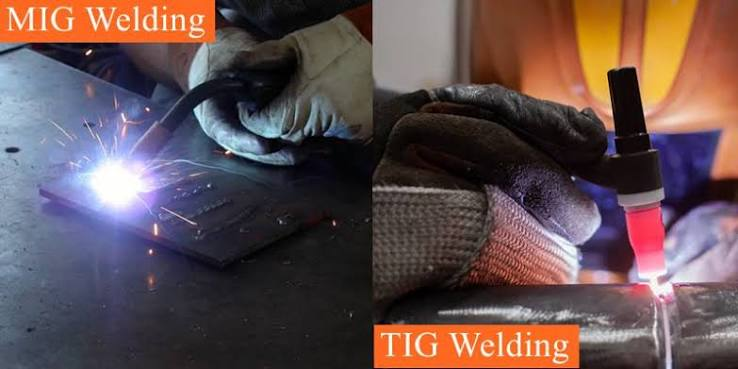

Quick Answer: MIG welding is faster and easier to learn, making it ideal for thicker materials and high-volume work, while TIG welding offers greater precision and cleaner welds, making it better suited for thin materials and detailed, high-quality finishes.
Choosing between MIG and TIG welding is one of the most common decisions in fabrication work. Both processes use an electric arc to join metal, but the techniques, equipment, and results differ significantly.
What Is MIG Welding?
MIG (Metal Inert Gas) welding uses a continuously fed wire electrode combined with a shielding gas. It’s known for its speed and relative ease of use, making it a popular choice for beginners and production environments alike.
Advantages of MIG welding:
- Faster welding speed
- Easier to learn and operate
- Great for thicker materials
- Produces less spatter with proper settings
What Is TIG Welding?
TIG (Tungsten Inert Gas) welding uses a non-consumable tungsten electrode and typically requires a separate filler rod, giving the welder precise control over the weld pool. This makes TIG welding a preferred method for detailed, high-precision work.
Advantages of TIG welding:
- Superior weld quality and appearance
- Better control over heat input
- Ideal for thin materials
- Works well on a wider range of metals, including aluminum and stainless steel
Key Differences at a Glance
| Factor | MIG Welding | TIG Welding |
| Speed | Faster | Slower |
| Skill Level | Beginner-friendly | Requires more practice |
| Precision | Moderate | High |
| Best For | Thick materials, production work | Thin materials, detailed finishes |
| Cost | Generally lower | Often higher due to equipment/time |
Choosing the Right Method for Your Project
The right choice depends on your priorities. If speed and efficiency matter most — such as in structural fabrication or automotive repair — MIG welding is usually the better fit. If your project demands precision, aesthetics, or work on thinner, more delicate materials, TIG welding is worth the extra time and skill investment. For a more detailed side-by-side comparison, including material-specific recommendations, this guide on MIG vs TIG welding is a solid resource for both beginners and experienced fabricators.
Can You Use Both?
Many professional welders are trained in both methods and choose based on the specific job requirements — using MIG for efficiency on larger structural components and switching to TIG for finishing touches or precision joints.
Final Thoughts
Neither MIG nor TIG welding is universally “better” — each excels in different scenarios. Understanding your project’s material, required precision, and timeline will guide you toward the method that delivers the best results.