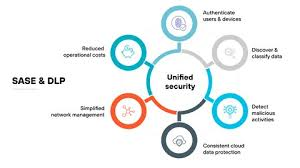

The way organizations connect their users, devices, and applications to the resources they need has changed dramatically over the past decade. Remote work became standard, cloud adoption accelerated, and enterprise environments spread across dozens of locations and provider networks. The result was a growing gap between how enterprise networks were built and the realities of how people actually work.
That gap led to the development of an architectural model designed to bring networking and security together under a single framework delivered from the cloud. That model is called Secure Access Service Edge, commonly known as SASE a term that describes both what the architecture does and how it delivers those capabilities.
Defining SASE
At its most basic level, SASE is a cloud-native framework that combines wide area networking capabilities with a comprehensive set of security services. It allows organizations to connect users and devices to applications securely, regardless of where those users are located or where those applications are hosted. The framework collapses what was once a collection of separate networking and security tools into a single, unified service delivered from the cloud edge.
The core components of most SASE architectures include software-defined wide area networking, which manages how traffic moves across an organization’s distributed environment, along with a set of cloud-delivered security functions. Those functions typically include secure web gateways that filter and inspect web traffic, cloud access security brokers that provide visibility into and control over cloud application use, zero trust network access that governs which users can reach which resources, and firewall capabilities delivered as a cloud service. Together, these elements form a cohesive architecture rather than a stack of independently managed point solutions.
The Problem SASE Was Built to Solve
Traditional enterprise network architectures were built around a central data center. Users within the corporate perimeter were considered trusted, and security tools were positioned at the perimeter’s edge to keep threats out. This model worked when most users worked from offices and most applications lived on company-owned servers.
Both of those conditions changed. Applications migrated to cloud platforms. Users began connecting from home networks, branch offices, hotels, and mobile devices. The old perimeter dissolved, and with it went the assumptions that traditional security models were built on.
Organizations that tried to maintain the old approach quickly ran into problems. Routing all user traffic through a central data center for inspection created latency and degraded the experience for users accessing cloud applications. Managing separate firewall appliances, VPN concentrators, and web filtering systems at dozens of locations required substantial IT resources. Enforcing a consistent security policy across all of those locations became increasingly difficult as the environment grew more complex.
SASE platform for distributed access directly addresses this problem by moving both networking and security capabilities to the cloud edge, where they can be applied close to users and applications without requiring traffic to backhaul through a central location.
How a SASE Platform Delivers Services
The delivery model for SASE is what distinguishes it most clearly from earlier approaches. Rather than deploying hardware appliances at every location, organizations connect to a distributed network of cloud points of presence. These are geographically distributed nodes where the SASE platform simultaneously applies networking optimization and security enforcement.
When a user in a branch office opens a cloud-hosted application, their traffic is routed to the nearest point of presence. At that point, the platform inspects the traffic, enforces security policy, and routes the connection to the appropriate destination. The user experiences a fast, secure connection. The organization gets consistent policy enforcement with full visibility without any of the complexity of routing that traffic through a central hub.
This model scales naturally. Adding a new location or onboarding a new class of users does not require deploying hardware. Configuration changes are made centrally and automatically propagate to all points of presence.
Zero Trust as a Core Principle
One of the defining features of a well-implemented SASE architecture is the integration of zero trust network access as a core access control mechanism. Rather than placing users on the corporate network and relying on perimeter controls to keep threats out, zero trust starts from the assumption that no user or device should be implicitly trusted even those already inside the network.
Every access request is evaluated against a set of defined policies. The user’s identity is verified. The health and compliance status of their device is checked. The context of the request what application they are trying to reach, from where, and at what time is considered. Only when all of those checks pass is the user granted access to the specific resource they requested, and nothing more.
This approach significantly limits the potential consequences of compromised credentials or infected devices. An attacker who obtains a valid username and password cannot automatically move laterally through the network; they are constrained by the same identity-based policies that govern legitimate users.
Visibility and Policy Management
A practical advantage that SASE platforms deliver is unified visibility across both networking and security events. In environments where network management and security operations run on separate tools, correlating a slow application connection with a potential security event requires pulling data from multiple systems and reconciling it manually. That process takes time and often produces gaps.
When both functions operate within a single platform, the data exists in one place. A network anomaly and the associated security event surface together, in the same console, with the same timestamp. Security teams can act faster and with more context.
Security professionals looking to understand how broader legal frameworks shape what an enterprise security posture must address may find this compliance laws overview from CSO Online a useful reference for mapping requirements across jurisdictions and industries.
Policy management also benefits from unification. Access rules, traffic inspection policies, and acceptable use configurations are defined once and enforced consistently across all users and locations. Changes do not need to be made separately in a firewall management console, a VPN policy editor, and a web filtering tool. They are made once and applied everywhere.
The Role of Identity in SASE
Identity becomes the new perimeter in a SASE architecture. Rather than trusting traffic based on its source network address, the platform trusts users based on verified identity and the policies associated with that identity. This shift has significant practical implications for how organizations manage access.
Users connect to specific applications rather than to a broad network segment. External contractors or partners can be given precisely scoped access to the tools they need without any exposure to the broader internal environment. When an employee leaves the organization, revoking their access means removing their identity from policy definitions not hunting down VPN credentials or access-listed firewall rules across multiple systems.
The relationship between identity controls and internal risk management has drawn increasing attention. Research into how insider threats develop across both negligent and malicious categories highlights why granular, identity-driven access controls matter. This insider threat research from Help Net Security outlines the distinctions between different threat types and the controls organizations can use to reduce exposure.
Frequently Asked Questions
What does SASE stand for and where did it come from?
SASE stands for Secure Access Service Edge. The term was introduced by industry analysts to describe a cloud-native architecture that converges networking and security services into a unified, cloud-delivered framework, a direct response to the limitations of traditional perimeter-based enterprise network security.
Is SASE the same as zero trust?
Zero trust is a security principle, while SASE is an architectural framework. SASE incorporates zero trust network access as one of its core components, meaning that access decisions within a SASE environment are governed by zero trust principles. The two concepts are complementary and closely related, but they are not identical.
How long does it typically take to deploy a SASE platform?
Deployment timelines vary depending on the size of the organization and the complexity of its existing environment. Cloud-native SASE platforms generally allow organizations to begin connecting users and enforcing policy faster than hardware-based approaches, since there is no physical equipment to stage, ship, and install at each location.